
I began my postdoctoral research position this autumn at the University of Jyväskylä, participating in our MODALITY -research project in which we examine data literacy and datafication in education. For me, these first months have been times of reflection, learning, and wondering.
But what I have learned about researching?
I think that the world is often perceived through certain thought models. So, when I try to make sense of research, what would be more suitable for a literacy expert than to approach it in terms of reading and writing?
Researching as reading
In particular, reading has deepened my understanding of the vast amount of knowledge available worldwide. I’m a person who loves browsing databases, reading articles, and understanding people’s thoughts. I am inspired by new ideas as well as by different ways of viewing the world.

However, the challenge is that there are only a certain number of hours available in the day. A key learning point has been to curate my reading more strictly and select what to read and for what purposes. It also affects reading intensity.
Reading helps you to read
One of the first tasks in this research project was to start a research review (about the concept of data literacy) that involved going through a vast amount of literature, particularly regarding how the concept is defined. I’ve noticed that the more you read the better you’ll become in reading. Quite shocking discovery!

By reading a lot of research, one can learn various kinds of readings. The reading process becomes more efficient and you learn to identify what you want to find in different texts. Not everything needs to be read in its entirety, because there might only be certain aspects of the articles that actually interest you.
For me there are articles that are:
- Essential: Fundamental to the research for example in terms of concepts, theories or methodologies, requiring thorough, in-depth reading and detailed note-taking.
- Generally Interesting: Relevant but not critical articles, suitable for skimming with selective highlighting and brief note-taking.
- Potentially Inspiring and Useful: Promising articles to be quickly assessed for their potential impact, determining if deeper focus is warranted.
Similarly, I’ve realized, like in many other things, that the more you invest in reading and how you take notes, the more you get out of it. This doesn’t necessarily mean that it leads to straightforward results, but that the ideas might surface unexpectedly later when you least expect them.
For instance, this year, I was on a train to the FERA Conference on Education in Vaasa, reading a work about the life of bell hooks. Although this work didn’t directly relate to my core research area, it somehow freed space for my imagination and thinking. At the same time, it sparked the idea for a new article manuscript.
What is the plural for writing?
The other half of being a researcher involves writing, bringing forth and expressing one’s thoughts.
I came to realize that collecting different writing guidebooks could almost be considered a hobby of mine; I have a small stack of them on my bookshelf.
This autumn, I have learned and gained experience in understanding that writing can mean many different things. It does not necessarily mean sitting in front of a laptop and producing fully formed thoughts through a keyboard into a document. There are many ways and places to write, and nowadays technology allows for the use of various tools to assist in writing.
I see writing as an area where one can continually develop, and there isn’t just one way to understand what good writing is. It depends a lot on the context.
Where to write
Just as there are many places to write, there are many opportunities to publish.
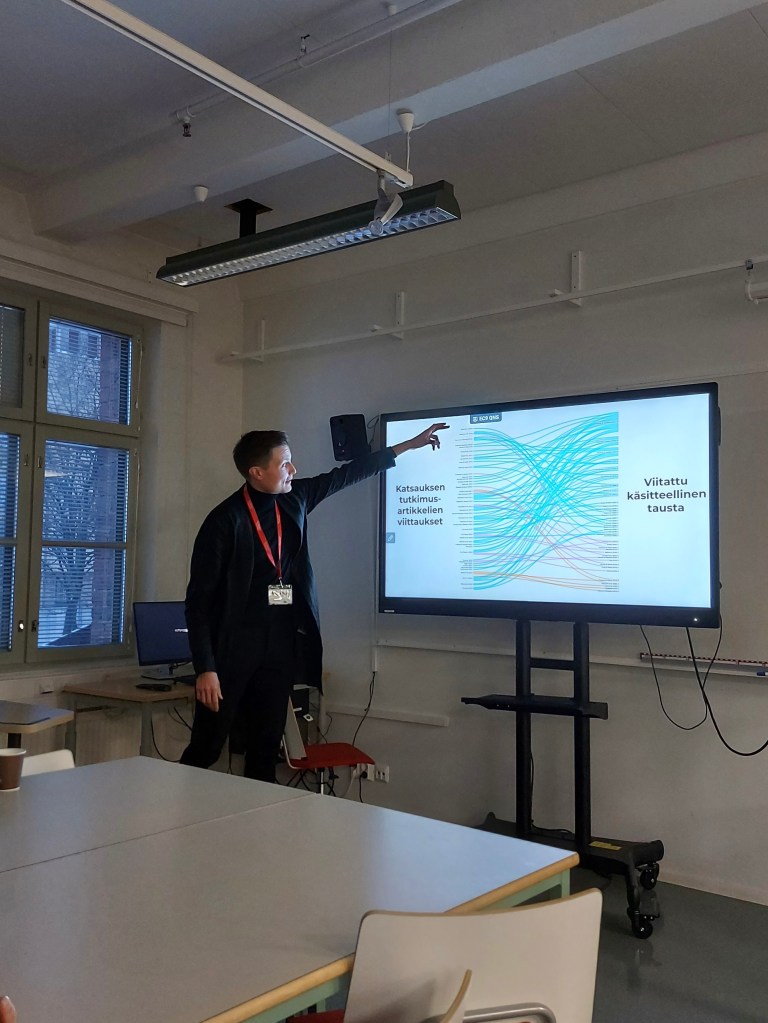
With our research team, we have discussed many different publishing platforms. For example, when considering where to submit a journal article manuscript, it is important to acknowledge that different journals may have different practices regarding how articles are constructed. Therefore, it’s important to consider the context in which one is writing.
Nevertheless, I believe that some things such as clarity, quality, and thoughtfulness are common in writing across different forums and contexts.
What is important is the writer’s ability to ease the reader’s reading process. If a writer grapples with fancy words and difficult terms for the sake of sounding impressive, it does a disservice to the reader, making their job harder. The clearer a writer can express their points, the easier it is for the reader. This is a key element of writing in which I want to improve and invest.
On the other hand, I believe that writing also involves a certain kind of ease: the more one forces it and the greater the pressure to produce a perfect text, the more difficult it becomes. However, if one can find some relaxation in writing (something I am trying to learn), a better flow can be achieved and ideas can be expressed more smoothly.
Writing together – for the world

The central aspect of writing is that it is not a solitary activity. Especially in scientific writing, the ideas and topics you write about and the discussions you partake in are always based on other people’s thoughts and work. The more you read, the more foundation you have for your thinking.
At the concrete level, it involves co-writing, discussing with others, clarifying thoughts, finding a common expression, and making choices about what to include and what to leave out, how to express things, in what order, and what kind of story the elements form.
Writing together involves the communal effort of going through issues, ideas, and concepts, constructively challenging and clarifying them, and considering different perspectives – all this to refine our thinking, express thoughts, participate in discussions, create opportunities for deepening shared understanding, and provide ways to act that can hopefully improve the world.
 Dr. Lauri Palsa